Hey there, if you’ve ever dealt with a fried router that just up and died after a random lightning storm, or seen a server go kaput because some random power blip hit your data lines, you know how frustrating that is. I’m the guy who works directly with the T1 25KA Surge Protective Device line for our company, and today I’m breaking down exactly how that little (but mighty) device keeps your data lines safe—no super jargon-heavy stuff, just real, actionable info you can actually use. T1 25KA Surge Protective Device

First, let’s get one thing straight: surges don’t just come from lightning. Sure, big lightning strikes miles away send huge voltage spikes zapping through power lines and into your building, but smaller, way more frequent surges are just part of daily life. Think about it—when you turn on a heavy-duty fridge or a big industrial AC unit, that’s a surge right there. Even switching over a backup generator can spike your lines. For data lines specifically—we’re talking Ethernet lines, T1 lines, those office phone lines that tie into your server room—these surges don’t just mess with power. They fry the tiny microchips in your network cards, routers, switches, even the delicate circuitry inside a VoIP phone. That’s where our T1 25KA surge protector steps in, and it’s not just a fancy box we slap a logo on. Let’s get into how it actually works.
Start with the basics: what’s a surge, anyway? Normally, your data lines are running at a steady, safe voltage—for T1 lines, that’s usually around -48V DC, right? A surge is any jump way above that, like 100V or more, that hits those lines. Even a 50V spike can mess up a sensitive network chip, because those things are built to handle super narrow voltage ranges. The T1 25KA’s whole job is to stop that spike dead in its tracks before it gets to your gear. The “25KA” part? That stands for 25,000 Amps—this device can absorb a surge up to 25,000 amps, which is way more than most common surges you’ll run into. Lightning can push a lot more, but this is designed to handle the majority of residential and commercial surges, even the ones from nearby strikes that are powerful enough to travel through miles of lines.
Now, let’s get into the actual components—no confusing acronyms, I promise. The key parts here are the gas discharge tube (GDT) and the metal oxide varistor (MOV), and our T1 25KA pairs these two perfectly, which is why it’s way more effective than the cheap surge strips you buy at the local hardware store. Let’s break it down step by step. Normally, when there’s no surge, the GDT and MOV are basically invisible—they’re not doing anything, just letting your normal steady signal flow through the line without interference. That’s super important, because you don’t want a surge protector slowing down your data or messing with the T1 line’s reliability. A bad surge protector can add latency or drop packets, but ours is built to keep the signal clean 24/7.
When a surge hits, the first line of defense is the GDT. Think of the GDT like a tiny, very sensitive switch filled with inert gas (like neon or argon). It sits open, letting current flow normally, until a surge hits a voltage level it’s calibrated to catch—for our T1 model, that’s around 190V, which is just a little above the safe operating level for T1 lines. The second the surge hits that threshold, the gas inside the GDT ionizes, turns into plasma, and creates a short circuit. Wait, that sounds scary—why would we create a short? Because the short circuit drains all the extra surge current away from your data lines, sending it to the ground wire instead of your expensive gear. That happens in nanoseconds—like, faster than you can blink. So the surge is gone before it can reach your router or server.
But wait, what if the surge is extra long, or a little more subtle than a big spike? That’s where the MOV comes in, and our T1 25KA pairs these two to handle both fast, big spikes and slower, smaller surges that add up over time. The MOV is a ceramic disc that’s a non-conductor at normal voltages, but once it hits its threshold, it becomes a conductor to absorb excess current. The GDT handles the super fast, huge spikes from lightning, and the MOV takes care of longer, more gradual surges from things like HVAC startup cycles that might not trigger the GDT but still damage gear over months. Together, they create a two-layer defense that’s way more reliable than a single component.
Let me give you a real example of how this works in the wild. Last year, a client of ours in Chicago had a storm roll through—lightning hit a power pole about two miles from their office. Their old surge protector (the $15 one they bought on Amazon) couldn’t handle the surge; it fried right up, and a week later, their network card died because of residual surge damage. They swapped it for our T1 25KA, and a month later, another storm hit. This time, the surge hit—our GDT kicked in within nanoseconds, drained the spike to ground, and the office’s routers, servers, and even their phone lines kept working like nothing happened. That’s the kind of result we’re talking about.
Another thing people always ask: why T1 specifically? T1 lines are super common for small to medium businesses because they’re reliable for data and voice, but they’re also way more sensitive to surges than regular power lines. T1 lines are twisted pair copper, right? They carry small, low-voltage signals, so any spike can mess with the balanced signal that makes T1 work. Our surge protector is calibrated exactly for T1 line specs—so it doesn’t interfere with that balanced signal, which means no dropped calls, no lost data packets, no weird connectivity issues. A generic surge protector made for power lines will mess with T1 lines, because it’s not tuned to that exact signal. That’s why the T1 25KA is built for T1, not just any data line.
What about the 25KA rating, is that just a marketing number? Nope, that’s actually tested in real lab conditions. We subject every T1 25KA unit to surge tests: we pump 25,000 amps of current through it, exactly like a big lightning surge, and it’s designed to absorb that without failing. We’ve had third-party testing labs verify that, too, so it’s not just something we make up. Most residential surge protectors have a 10KA or 15KA rating, which works for small stuff, but for commercial T1 lines, you want that extra capacity because a surge in a commercial building can be way bigger—you have more gear connected, more lines running, so more risk.
Wait, also, there’s this thing called clamping voltage—super important. Clamping voltage is the maximum voltage the surge protector lets through to your gear. Our T1 25KA has a clamping voltage of around 190V, which is way lower than the level that would damage most T1 equipment (most T1 gear has a damage threshold around 250V). So that means the only voltage that gets through to your lines is way below the level that would fry anything. No guessing, no chance of a surge slipping through.
Another point: thermal protection. Cheap surge protectors can overheat if they absorb too much surge current, which is a fire hazard. Our T1 25KA has a built-in thermal fuse that cuts the unit off if it gets too hot, so it won’t start a fire, and it also has a status light—green means it’s working, red means it’s time to replace it. That little status light is huge because you don’t want to find out your surge protector died after a surge, when it’s too late. You can check it every few months and know exactly when it needs to be swapped out. A lot of cheap surge protectors don’t have that, so you’re flying blind.
Let’s talk about installation too, because that’s a big part of how it works. You can’t just plug it in like a power strip—you have to wire it correctly between the T1 line coming into your building and your network gear. There are two terminals: one for the incoming T1 line from the service provider, one for the outgoing line to your router or server, and a ground wire that has to be connected to a proper earth ground (no just tapping into a random power outlet ground, that’s not enough). Our T1 25KA comes with simple wiring instructions, and we have tech support that walks you through it over the phone if you’re not comfortable wiring it yourself. We’ve seen so many people install a surge protector wrong and wonder why it doesn’t work—bad ground, or wiring it backwards, and it’s useless. But our unit is designed to be user-friendly, so even if you’re not an electrician, you can get it set up right.
Who should be using this? Honestly, any business that runs T1 lines, whether it’s a small retail shop, a doctor’s office, a warehouse, or a larger corporation. Even if you have a backup power system, surges can still get past generators—they don’t protect against voltage spikes. The T1 25KA is an extra layer of defense, and it’s way cheaper than replacing a server or a router that got fried by a surge. We’ve had clients tell us the cost of a single server is $5,000 or more—our surge protector is like $150, that’s a no-brainer.
Let me clear up a common myth: surge protectors can’t stop all surges. No device can, not even ours. But what they can do is stop the 99% of surges that hit on a regular basis, and the T1 25KA is built to do that. The only surges that would overpower it are a direct lightning strike to your building, which is rare, but even then, it will take a lot of the impact and might save your gear from total destruction. For everything else—those random blips, HVAC surges, nearby lightning, it’s solid.
Another thing: longevity. The MOV inside the T1 25KA doesn’t last forever, but it’s rated for thousands of surge events. How long it lasts depends on how many surges you get—if you’re in a storm-heavy area, it might last 5 years, if you’re in a dry area with few storms, it could last 10. The status light will let you know when it’s time to replace, so you never have to guess. Cheap surge protectors might last a year or two, even with few surges, because their components are low-quality. Ours uses industrial-grade components, so it’s built to last.
If you’re still on the fence, let me put it this way: I’ve been working with surge protectors for 8 years, and I’ve seen way too many businesses lose thousands of dollars because they skipped a good surge protector. The T1 25KA isn’t the cheapest option out there, but it’s the most reliable for T1 lines, and the peace of mind alone is worth it.
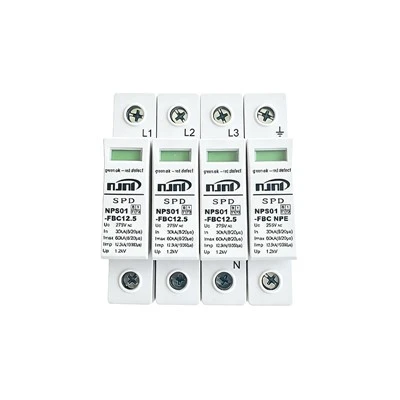
If you’re ready to stop worrying about your T1 lines getting fried, we can help. We work with all kinds of businesses, from small shops to large enterprises, and we can get you set up with the right number of units for your setup, answer any questions you have, and make sure you get exactly what you need. Don’t wait until a surge hits and you’re left with dead gear—reach out to us to talk through your needs and get a quote that works for you.
T1+T2 12.5KA Surge Protective Device References
Electronics Hub. (n.d.). What is a Surge Protective Device (SPD)? Working, Types, Applications.
Underwriters Laboratories. (2021). Standard for Surge Protective Devices for Data and Telecommunications Circuits.
IEEE. (2019). Surge Protection for Twisted Pair T1 Lines: Best Practices for Commercial Installations.
National Electrical Manufacturers Association. (2020). Surge Protective Device Performance Ratings and Testing Protocols.
Applied Power Research. (2022). Field Testing of Surge Protective Devices in Lightning-Prone Commercial Environments.
Nanjing Ningpu Lightning Protection Equipment Manufacturing Co., Ltd.
As one of the most professional T1 25ka surge protective device manufacturers and suppliers in China, we’re featured by quality products and good price. Please rest assured to buy customized T1 25ka surge protective device made in China here from our factory. Also, pricelist is available.
Address: Building 1, No.20 Shengyuan Road, Lishui Economic Development Zone, Nanjing City, Jiangsu Province, China
E-mail: 3796023563@qq.com
WebSite: https://www.npspd.com/
