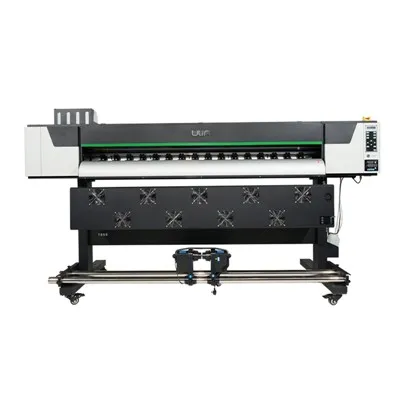
When it comes to the world of large – scale printing, eco – solvent printers have carved out a significant niche. As a leading supplier in this industry, I’ve been asked countless times about the power consumption of these remarkable machines. In this blog post, I’ll delve into the nuances of eco – solvent printer power use, exploring the factors that influence it, how it compares to other printing technologies, and what this means for your business’s bottom line. Eco Solvent Printer
Understanding the Basics of Power Consumption
Power consumption is measured in watts (W), and it represents the rate at which an electrical device uses energy. For an eco – solvent printer, this is a crucial metric as it directly impacts operating costs. The total energy consumption over a period of time (usually measured in kilowatt – hours, kWh) can be calculated by multiplying the power (in kW) by the time (in hours) the printer is in use.
The power consumption of an eco – solvent printer is not a fixed value. It can vary widely depending on several factors, including the printer’s size, model, and the type of print jobs it is performing. For instance, a small – format desktop eco – solvent printer may have a lower power consumption compared to a large – format floor – standing model.
Factors Influencing Power Consumption
Printer Size and Model
Larger printers generally require more power to operate. This is because they have larger print heads, more motors to drive the print carriage and media feed, and often more advanced control systems. For example, a wide – format eco – solvent printer designed for billboard and banner printing may have a power rating of 1500 – 2000 watts during active printing. In contrast, a smaller desktop model used for printing small signs or labels might consume only 300 – 500 watts.
Different printer models also have different power – saving features. Some printers are equipped with intelligent sleep modes that automatically reduce power consumption when the printer is idle for a certain period. These features can significantly lower the overall energy usage of the printer over time.
Print Mode and Quality
The print mode and quality settings you choose can also have a substantial impact on power consumption. High – resolution printing requires the print head to make more passes over the media, which means the printer has to work harder and use more power. For example, printing at 1440 dpi (dots per inch) will consume more energy than printing at 720 dpi.
Similarly, printing in a draft mode, which is faster but of lower quality, generally uses less power as the printer makes fewer passes and applies less ink. If your business can tolerate a slightly lower print quality for some jobs, switching to a draft mode can result in significant energy savings.
Inkjet Technology
The type of inkjet technology used in the printer can affect power consumption. Some eco – solvent printers use piezoelectric print heads, while others use thermal print heads. Piezoelectric print heads use an electrical charge to force ink out of the nozzles, and they tend to be more energy – efficient compared to thermal print heads, which heat the ink to create a bubble that expels the ink.
Media Handling
The process of feeding and moving the media through the printer also consumes power. Printers that can handle a wider range of media thicknesses and sizes may require more powerful motors to ensure smooth and accurate media transport. Additionally, printers with advanced media handling features such as automatic double – sided printing or roll – to – roll printing may use more energy due to the additional mechanical components involved.
Comparing Power Consumption with Other Printing Technologies
When evaluating the power consumption of eco – solvent printers, it’s useful to compare them with other common printing technologies.
Traditional Solvent Printers
Traditional solvent printers are known for their high power consumption. These printers often use large heaters to dry the solvent – based ink quickly, which can be a major energy drain. In contrast, eco – solvent inks are designed to dry more quickly at lower temperatures, reducing the need for high – power heating elements. As a result, eco – solvent printers generally consume less power than their traditional solvent counterparts.
UV Printers
UV printers use ultraviolet light to cure the ink instantly. While they offer high – quality prints and fast production times, the UV lamps used in these printers can be very power – hungry. Eco – solvent printers, on the other hand, do not require such high – energy UV curing systems, making them more energy – efficient in comparison.
Laser Printers
Laser printers are typically very efficient for small – to – medium – volume printing. However, they are not suitable for large – format printing, which is the primary application of eco – solvent printers. In large – format printing scenarios, eco – solvent printers are more cost – effective in terms of power consumption, especially when considering the long – term energy costs associated with running a large – scale laser printing operation.
Calculating the Cost of Power Consumption
To understand the financial impact of power consumption, you need to calculate the cost of running your eco – solvent printer. First, you need to know the printer’s power rating (in watts) and the number of hours it is in use. You can then convert the power rating to kilowatts (by dividing by 1000) and multiply it by the number of hours of use to get the energy consumption in kilowatt – hours (kWh).
Once you have the energy consumption, you can multiply it by the cost per kWh charged by your electricity provider. For example, if your eco – solvent printer has a power rating of 1000 watts (1 kW), and you use it for 8 hours a day, 5 days a week, the weekly energy consumption would be 1 kW x 8 hours x 5 days = 40 kWh. If your electricity provider charges $0.15 per kWh, the weekly cost of running the printer would be 40 kWh x $0.15/kWh = $6.
Strategies to Reduce Power Consumption
As an eco – solvent printer supplier, I’m always looking for ways to help my customers reduce their operating costs. Here are some strategies that can help you lower the power consumption of your eco – solvent printer:
Optimize Print Settings
As mentioned earlier, choosing the right print mode and quality settings can make a big difference. Use draft mode for less critical jobs and only switch to high – resolution mode when necessary. Also, make sure to calibrate your printer regularly to ensure that it is using ink efficiently, as over – inked prints can increase power consumption.
Use Power – Saving Features
Take advantage of the printer’s power – saving features, such as sleep mode and automatic shutdown. Set the sleep mode to activate after a short period of inactivity, and enable the automatic shutdown feature to turn off the printer completely when it is not needed.
Maintain Your Printer
Regular maintenance of your printer can also help reduce power consumption. Keep the print heads clean to ensure smooth ink flow, and replace worn – out parts promptly. A well – maintained printer will operate more efficiently and use less power.
Conclusion

In conclusion, the power consumption of an eco – solvent printer is influenced by several factors, including printer size, print mode, inkjet technology, and media handling. While larger and high – performance printers generally use more power, there are many ways to reduce energy usage and lower your operating costs.
Eco Solvent Printer As a supplier, I’m committed to providing you with the most energy – efficient eco – solvent printers on the market. If you’re interested in learning more about our products or have any questions about power consumption, I encourage you to get in touch. Our team of experts is ready to help you find the perfect printer for your business and guide you on how to optimize its energy usage.
References
- "Printers and Their Energy Consumption: A Comprehensive Guide" – A technical report on printer energy efficiency.
- Annual reports from major printer manufacturers on eco – solvent printer models and their power specifications.
- Industry research papers on the comparison of different printing technologies in terms of energy use.
Hangzhou Yulan Technology Co., Ltd.
Hangzhou Yulan Technology Co., Ltd. is one of the most professional eco solvent printer manufacturers and suppliers in China. With abundant experience, we warmly welcome you to wholesale the newest eco solvent printer in stock here from our factory. Good service and quality products are available.
Address: Building, No.128 Rihui Road, Linping District, Hangzhou, China.
E-mail: ulinprint@gmail.com
WebSite: https://www.ulinprinter.com/
