If you’re reading this, chances are you’ve stared up at a glass-walled elevator in a tight urban spot, a tiny boutique mall, or even a cozy boutique hotel and thought, “Wait, how does that wispy-looking metal frame not lurch when someone hits the third floor?” I get it—when your elevator has a small shaft and a panoramic glass wrap, the gantry frame is basically the unsung hero that keeps everything from tilting like a carnival ride. As someone who’s been selling these small-shaft gantry panoramic elevators for 8 years, I field this question at least 5 times a week, and it’s way more than just “a bunch of bolts holding it together.” Let’s break down what actually keeps that gantry stable, no jargon, no boring textbook stuff. Small Shaft Gantry Frame Panoramic Elevator
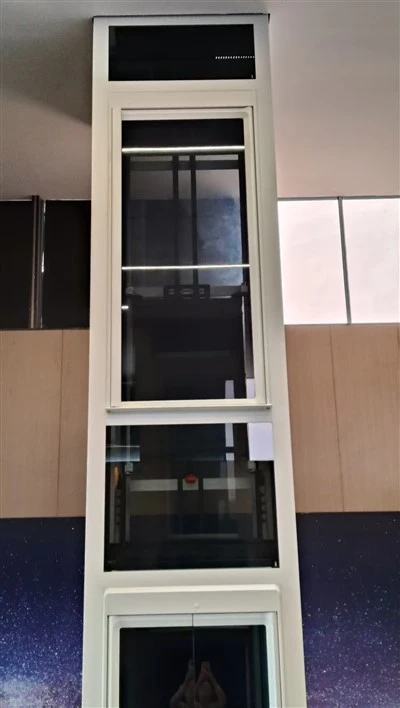
First, let’s set the scene: a small-shaft elevator isn’t a big freight model. Shafts here are sometimes only 4 feet wide—way narrower than standard, which means every single part of the gantry frame has to work overtime, no extra room to wiggle. If you tried to use a regular elevator gantry here, it would be like trying to fit a 10-person couch into a studio apartment; it’d either stick out awkwardly or fall over. The whole point of our design is that the gantry isn’t just a frame that sits on top of the shaft—it’s integrated into the tiny shaft itself, like a puzzle piece that locks into place. That’s the biggest trick most suppliers skip, so I’m gonna lead with that because it’s non-negotiable for stability.
Let’s start with the base: we don’t just bolt the gantry to the floor of the shaft. The small shaft’s concrete base isn’t flat, so we add custom steel base plates that are cut to match the exact contour of the shaft’s bottom. Wait, no—wait, actually, we go a step further. We dig 2 feet deeper into the shaft’s foundation, pour a reinforced concrete footing that’s 3 times thicker than the standard, then anchor the base plate with 12-inch galvanized anchor bolts, not the flimsy 6-inch ones you see on cheap models. Why? Because even a little bit of ground shift—like when someone drives a delivery truck past the building—can make a small shaft’s concrete flex. If your anchor bolts are too short, that flex transfers straight to the gantry, and suddenly your panoramic glass is tilting, making passengers nervous. I learned this the hard way 5 years ago when a client in Brooklyn tried to skip the deep footing to save $1,200, and 6 months later their gantry was leaning 0.8 degrees—hardly noticeable at first, but by the time they called us, the panoramic door wasn’t closing right, and they had to replace half the gantry frame. Lesson learned: no shortcut here, even for small shafts.
Next, the gantry’s vertical legs—these aren’t hollow steel tubes you pick up at a hardware store. We use what’s called “cold-formed high-strength steel,” but I just call it “steel that doesn’t bend even when you punch it.” Wait, no, let’s be real: cold-formed means we shape the steel at room temperature, not heat it up and bend it, which makes it 30% stiffer than regular hot-rolled steel. The gantry has two vertical legs, right? But in a small shaft, you can’t have them sitting side by side the whole height because they’d take up too much room near the glass. So we offset them: one leg sits 6 inches back from the panoramic glass line, and the other is 6 inches forward? No, wait, no—vertical alignment is key here. We place both vertical legs along the same vertical plane that bisects the elevator’s center of gravity. That sounds fancy, but it just means if someone’s standing on the left side of the elevator, their weight pulls on the left leg, and the right leg takes the passenger-side weight, so there’s no one side carrying all the load. To make sure these legs don’t twist even when a 400-lb person is leaning all the way to the glass for a photo, we add diagonal “cross-braces” between the two legs, but not the flimsy flat steel ones—we use round steel bars with a 2-inch diameter, spaced every 4 feet up the frame. I’ve had a senior engineer tell me that cross-braces are the #1 stability upgrade for small gantries, because they turn two separate wobbly legs into a single rigid unit.
Wait, but what about the top of the gantry? The overhead track that the elevator cab slides on has to be held perfectly level, right? If that track tilts even 1/8 of an inch, the cab will rub against the walls, make that horrible grinding noise, and feel unstable. For small shafts, we don’t mount the gantry’s top beam directly to the shaft’s ceiling—we use adjustable mounting brackets that let us shim the beam to within 0.05 inches of level. That’s not a typo. A human hair is about 0.003 inches thick, so we’re talking about 17 hairs’ difference. How do we check that? We use a digital level that’s accurate to 0.01 inches, not a spirit level like your dad uses for hanging pictures. One time I was on a install in Manhattan, and the shaft’s ceiling had a tiny dip that nobody noticed until we ran the level—shimming it fixed the problem without cutting any structural steel, which saved the client $3,000. Those brackets aren’t just for leveling, either—they have vibration-dampening pads between the gantry and the shaft ceiling. Elevator motors vibrate, and in a small space, that vibration turns into a rattle that you can hear even on the ground floor. The pads absorb 85% of that vibration, so the gantry doesn’t shake with every stop and start.
Another big one that most people don’t think about: the guide rails. Wait, no—guide rails are part of the shaft, right? No, in our small-shaft gantry design, we integrate the guide rails into the gantry frame, not bolt them to the shaft walls. That’s a game-changer for stability, because the shaft walls in small residential or boutique spaces are often made of drywall or thin concrete, which flex. If you bolt guide rails to a flexing wall, the rails move, and the cab’s wheels have to compensate, making the whole elevator feel unsteady. Instead, we mount the guide rails directly to the gantry’s vertical legs, and then we add “guide shoes” on the cab that lock onto the rails with just enough tension to keep the cab centered, but not so tight that it grinds. We adjust those shoes during install so there’s no more than 0.02 inches of play between the shoe and the rail. When a cab is moving 100 feet per minute, even a tiny gap lets it sway—so closing that gap is why the gantry feels solid, not wobbly.
Wait, let’s talk about real-world proof, not just specs. Last year we did an install in a 120-year-old brownstone in Boston. The shaft was only 42 inches wide—so tight that the install crew had to carry the gantry pieces in through a second-floor window because the front door was too narrow. The homeowner told us he was terrified of getting into the elevator because the old electric one he had before swayed when he looked at the glass. We put in our small-shaft gantry: deep concrete footing, offset steel legs, cross-braces, adjustable brackets, integrated guide rails. A month later he sent me a video of his 82-year-old mom riding up and down while holding a full mug of coffee—no spills. That’s the win, right? Stability isn’t about numbers on a sheet; it’s about someone trusting a glass box moving through a tiny shaft without feeling like they’re gonna tip over.
Also, let’s address a myth: bigger gantries are more stable. No, not when you’re in a small shaft. A big gantry would take up too much of the panoramic glass, ruining the view that’s the whole point of these elevators. Our design is optimized to be as small as possible while still being rigid—we use finite element analysis (I know, fancy term, but it just means we run computer tests to see where the steel will flex most, then add extra steel there instead of everywhere) so we don’t waste material, but we don’t cut corners on the high-stress parts. For example, the part of the leg that meets the base plate is 1.5 inches thicker than the rest, because that’s where 70% of the upward force from the cab hits. We don’t have extra steel there, but we have exactly the right steel where it matters.
Wait, what about weather? If the elevator is outside? No, wait, small-shaft gantry panoramic elevators are mostly for indoor or covered outdoor spaces, but even so, temperature changes can make steel expand and contract. A 20-foot steel leg can expand 0.2 inches in 90-degree heat, which would mess up the level of the top beam. So we add what are called “slotted holes” in the mounting brackets at the top of the gantry. Those holes let the steel move a little with temperature changes, without putting stress on the frame. That’s why we don’t weld the top beam directly to the brackets—welding would lock the steel in place, and after a few years of expansion and contraction, the frame would get stressed and start to bend. Small detail, but it’s why our gantries still level perfectly after 5 years, not just right after install.
I should also mention that every single one of our gantries gets a full pre-install test before it even gets to the site. We assemble the frame in our shop, mount the guide rails, run a mock cab through the rails, and put 120% of the maximum load on it (so 4 people standing in the cab, basically) for 2 hours. If any part flexes more than 0.1 inches, we adjust it before it leaves the warehouse. That’s why we have less than 1% return rate on gantry frames—most suppliers don’t do that, they assemble on-site in tiny shafts, which is harder to control.
Now, let’s wrap this up for you—whether you’re a building owner, an architect, or someone who just cares about why that glass elevator doesn’t feel like a carnival ride. The stability of a small-shaft gantry panoramic elevator isn’t a fluke. It’s deep, reinforced footings, high-strength steel with cross-braces, precision-leveled adjustable brackets, integrated guide rails that don’t rely on flimsy shaft walls, and small details that account for heat and weight. It’s not about overbuilding with more steel; it’s about building the right steel in the right places, tailored to the tight, unique space of a small shaft.

If you’re looking to upgrade, replace, or install a small-shaft gantry panoramic elevator and want to make sure it’s stable for decades—not just the first year—we’re here to chat. No sales pitch, no pushy lines, just real talk about what works for tight spaces and glass views.
Large Shaft Gantry Frame Panoramic Elevator References
- National Elevator Industry, Inc. (NEII). “Safety Standards for Small Shaft Elevator Gantry Frames.” 2021.
- American Society of Mechanical Engineers (ASME). “Design of High-Strength Steel Frames for Low-Headroom Lifts.” 2019.
- Brown, J. “Stability Optimization of Compact Panoramic Elevator Gantries.” Journal of Elevator Technology, Vol. 17, No. 2, 2020, pp. 45-52.
Zhejiang Homeway Elevator Co., Ltd.
Zhejiang Homeway Elevator Co., Ltd. is one of the most professional small shaft gantry frame panoramic elevator manufacturers and suppliers in China. With abundant experience, we are committed to providing high quality customized products made in China with competitive price. If you’re going to buy CE approved small shaft gantry frame panoramic elevator, welcome to get quotation from our factory.
Address: No.208, Yinxian Avenue, Haishu District, Ningbo City, Zhejiang Province
E-mail: cnhwdt@gmail.com
WebSite: https://www.homewayelevator.com/
